Tuesday, October 26, 2010

The worst movie I've seen in a long time award goes to Killer Inside Me, a movie that has been trying to get made for decades, based off of an infamous hardboiled novel (a touchstone in the noir universe) which Stanley Kubrick found disturbing. It's about a young smalltown sheriff with some serious, sick repressed tendencies who copes with his issues by being sickeningly cliche in his interactions with people (an element the film did not touch on, or if it did I sure missed it). A loose woman comes into town, and she unleashes all of his twisted stuff (she apparently understands him), but he winds up killing her and a ton of other people in violent ways, all while keeping up appearances. There's alot of ways you could have gone with a story as dark as this, and the director and screenwriters apparently chose irony, juxtaposition, and extreme violence towards the female characters to convey the sheriff's descent. This, for some- or many- reason(s) fails, hard, and becomes a fairly boring film with no hook, really, and an ending I couldn't have cared less about. Well, maybe not less, but I certainly wasn't hanging on Casey Affleck's every word.

One of the few things the film brings across well is the brutal beating violence that Affleck inflicts on two of the female characters. That is, this would have been pulled off had the movie been of quality. Morally, when it comes to scenes such as that (in this case, Jessica Alba's prostitute gets repeatedly beaten in the face while Kate Hudson gets punched in the stomach and lies struggling for breath on the floor, her dress covering her face, until Affleck finally ends the suffering), I wonder about their right to exist, and in the end I think it's alright, though admittedly a bit of a grey area, like any sort of reprehensible behavior put onscreen. I'm anti-censorship and believe that only parents and nurturing surroundings can help prevent impressionable young people from doing such reprehensible things, however it is undeniable that film is a powerful medium and so long as it has influence on what people wear or say, it will inspire people in other ways. I've thought about and often discussed with others the Artist's Responsibility, that is, the creator's duty to make his or her point as clear as possible, and to be aware of such negative inspirations on the audience (should Mel Gibson have changed Passion of the Christ by removing objectionable parts quoted directly from the Bible? no, but perhaps he should have added a foreward to the film condemning anti-semitism for those crazies who might think The Passion was some kind of call to arms... though he refused to do that because he thought that would be an indication that there was something improper about his film. que sera sera). Point being, artists should make sure that such material is damn necessary and effective before just tossing it in the salad.
Anyway, the violence is the only thing that has caught anyone's attention about this film, and that makes sense. I was a little surprised by how cringe-worthy Alba's death was, because I thought that I had seen "beatings" in films, but this was different-- there were very few cuts, the camera was unflinching as Affleck just punched her face repeatedly, prompting me to wonder how many things in the human face can be broken. Really horrible stuff-- which would have been suitable if the film had ANYTHING to say, or any flair with which to say it. Affleck is this completely Evil Man with a wicked past and a mother who liked masochism. Apparently the mother part messed him up, but that's the only light we see in Affleck's head. Killers kill due to compulsion, disgust, sexual thrill, or material motivation, and I guess Affleck is supposed to be starting here with the very former, but we don't see any of that. He just starts killing folks. We get the impression that he's supposed to be sort of brilliant to get away with all of this, but the film never really lets us feel that he's brilliant, despite his annoying, excessive voice-over narration, which is another thing that was all wrong here-- the VO could have been crucial, bone-chilling, Lector-level creepy but again the director goes for irony-- isn't it creepy that Affleck is so bland, isn't it spooky that he just HAS to kill like that?! Misses the mark completely. There's also a theme of old-country tunes sprinkled throughout, which is kind of interesting but the style of the film is so flat already that the tunes become gimmicky and super-annoying.

With the best thriller/horror/evil-psycho-man movies there's a sense of dread, and every time another one bites the dust, the audience bites their nails, thinking dammit, I liked that one, I thought he was going to live! They're pulled in by their fascination with the antagonist because, as my Irish Lit professor pointed out, the most frightening is that which is like us but not (vampires, werewolves, Hannibal Lector). Alas, this just doesn't happen, but it's not the cast's fault. Firstly, most of the main players are miscast. Jessica Alba cannot act, she needs to go away, and though I will admit that this is the best I've seen her, she's not suited for it. Kate Hudson is all right, but overall underused, underdeveloped, and as an actress she seems a bit lost despite trying very hard. Casey Affleck is one of my most favorite actors, and he does a great job with the directions and script he's given, but the character just isn't there. Nevertheless, I do admire his subtlety in this role, his twitches and dry, Texan voice work well, and I think he could have pulled it off under different circumstances-- STILL, I don't believe he was the best choice for the role at all. It should have been someone a bit bigger and more commanding, charismatic, while still being able to anchor himself with dorkish, bore-of-a-sheriff-ness. The two actors I really did love in the film had criminally insignificant parts: Bill Pullman had a great few minutes as a fake-irate lawyer that rescues Affleck from an asylum, and that guy from the Mentalist plays the investigator of Affleck's murders (but, like alot of other folks in this movie, Mr. Mentalist seems to have nothing to do).

Towards the end of the film all of Affleck's lies are starting to unravel and we're supposed to feel the tension, but there is none, because nobody really cares. I mean, you're a bit curious to know how this guy is going to go down, but even when that happens it's underwhelming and the ultimate assurance that there was no reason to sit through this movie that's grabbing only in its let's-beat-up-the-girls moments, which ultimately makes the film more than a fail. Without any backbone or character truth, those scenes are worse than cringey, they're pointless. About twenty minutes worth of women being attacked by a man (who "loves them") to no end, which, if you ask me, is pretty dirty.

Fucked. Up.

Wednesday, September 15, 2010

watched recently:

the pledge
the prestige
youth in revolt
book of eli
harry brown
the switch
fallen
fast track
ghost writer
The Town


the following from the library:

The butcher boy
by Morris, Redmond.
08/25/2010 09/15/2010 0

Detour
by Goldsmith, Martin, 1913-1994.
08/25/2010 09/15/2010 0
Elevator to the gallows
by Malle, Louis, 1932-1995.
08/25/2010 09/15/2010 0
The heart is a lonely hunter /
by McCullers, Carson, 1917-1967.
08/25/2010 09/15/2010 0
Her majesty Mrs. Brown
by Madden, John.
08/25/2010 09/15/2010 0
Hombre
by Ravetch, Irving.
08/25/2010 09/15/2010 0
The left handed gun
by Penn, Arthur, 1922-
08/25/2010 09/15/2010 0
The Mackintosh man
by Huston, John, 1906-1987.
08/25/2010 09/15/2010 0

Pocket money
by Foreman, John, 1925-1992.
08/25/2010 09/15/2010 0
Rififi
by Dassin, Jules, 1911-
08/25/2010 09/15/2010 0
Sweet land
by Reaser, Elizabeth.
08/25/2010 09/15/2010 0
The testament of Dr. Mabuse Das testament des Dr. Mabuse /
by Lang, Fritz, 1890-1976.
08/25/2010 09/15/2010 0
World traveler
by Crudup, Billy, 1968-
08/25/2010 09/15/2010 0
You can count on me
by Hart, John N.
08/25/2010 09/15/2010 0
You only live once
by Wanger, Walter, 1894-1968.
08/25/2010 09/15/2010 0
Young Mr. Lincoln
by Zanuck, Darryl Francis, 1902-1979.

assessment at some other time. have to keep 'em all straight, of course.

want to watch soon: The Piano, Robin Hood, Ondine, Dinner for Schmucks, Get Him To The Greek, Killer Inside Me, Thirteen Conversations about One Thing and finish Stolen. Which is a yawn, but Jon Hamm is in it so that makes it worth watching at least.

Sunday, September 5, 2010

Predators.


Bad, bad. Bad. Strangely, did not even feel like a movie, despite the fact that the concept is really interesting.

Also, I never knew I could not care for or even dislike Adrien Brody, but this one did it. Not because of his character, but the knowledge that he WANTED to play this character.

I thought it might be good because Rodriguez's name is on it, however it took me some time to realize that he was not, in fact, the director. All in all quite a pointless thing with a nonsensical ending, though I suppose it deserves props for the character surprise at the end-- the actor is pretty good-- trying his best-- though, again, said twist makes noooo sense at all.

Saturday, September 4, 2010

the best of 2010, from my perspective, thus far:

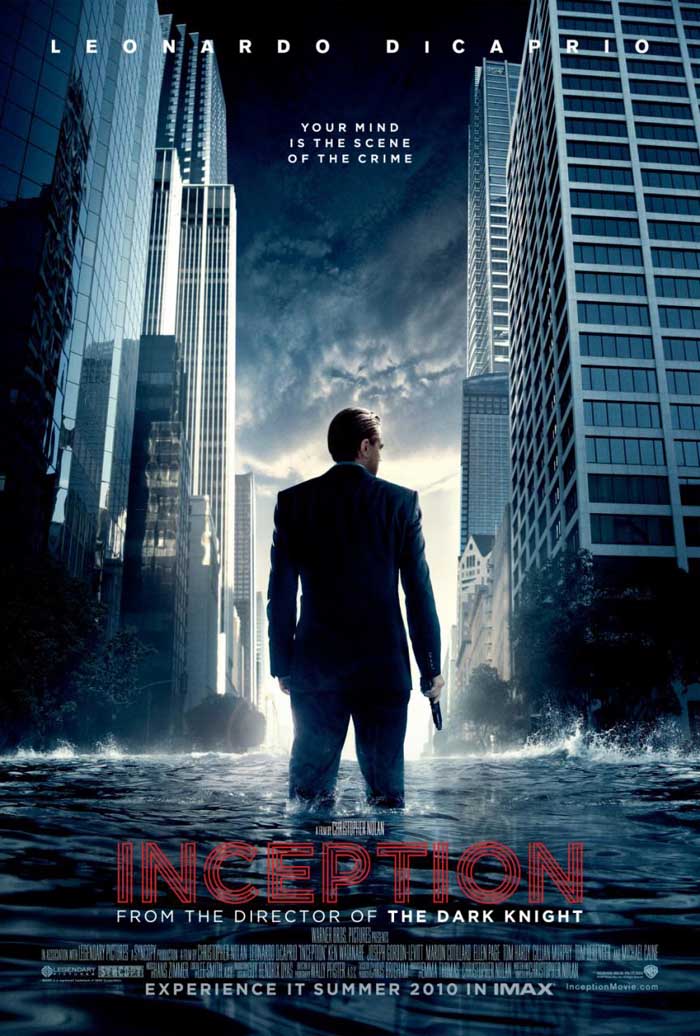
Inception

Greenberg

The Switch (believe it or not)

Toy Story 3

Kick-Ass

Defendor

Peacock

I still have to see Solitary Man, Please Give, Get Him To The Greek, Scott Pilgrim Vs. The World, Book of Eli, The Kids Are Alright, & How To Train Your Dragon.

I also have hopes for The Town, Howl, It's Kind of A Funny Story, The Social Network, Hereafter (Clinty!), The Company Men (schmaltzy, probably, but I almost cried at the trailer so I will probably turn to putty despite the sight of Ben Affleck's chin), Red, Conviction, The Tempest, How Do You Know (Owen Wilson! glad to see you playing a human being again), Black Swan, True Grit, Blue Valentine, Morning Glory, Due Date, The King's Speech, Country Strong, SOMEWHERE.

The Romantics and Don't Let Me Go also look promising, but I find their respective leads unsavory. Keira Knightley bleh.

Inception


I finally saw Inception this week. Though it was not exactly what I had hoped it would be, it definitely left me in awe, especially in regards to Chris Nolan's mastery-- mainly in the construction of the story, regardless of the deft filmmaking. How did he manage to think up something like that, let alone present it in such a logical, easy-to-follow way (well, relatively easy to follow. i'm not sure I took in certain meanings and rules about the constructs of the dreams-- my ADD once again distracted me-- but I followed the plot, the levels of subconsciousness, very easily). I have further thoughts on the matter, but concisely:

did not like:
As amazing as the movie was, I was hoping the worlds would be more as they were presented in the kick-ass trailer-- dark and crazy weird. More stuff like the train appearing in the middle of the street, the non-gravity level, feeling a true, creepy threat from Mal and Cobb's subconcious. I understand and appreciate that Nolan made an artistic decision to create the dreams/subconscious as LOGICALLY as possible, having each make as much sense in reference to its surroundings as possible. No appearance of giant dinos, or Harrison Ford playing the ukulele or anything like that. And this actually makes sense too, because as Cobb says when explaining it all to Ellen Page, dreams make perfect sense when you're experiencing them. it's only when you wake up that you realize that something was weird (ALTHOUGH on that same subject, Saito knew something was amiss during Cobb's "audition" at the beginning-- the carpet wasn't right. so, HM). ANYWAY. I get Nolan's decision to make things as he did, however I just wanted something darker, creepier. I read somewhere that he originally imagined the film as more of a horror, and then later crafted it into a heist picture. I would've liked a little more horror, please.

[basically, i think i would have liked it if it were more like the trailer:


My main beef with the film: Incredible a spectacle as it is, you have to have emotional resonance in a movie like this. The Cobb/Mal love story/tragedy was not solid. Marion Whatsherface is a great actress, and DiCaprio can do anything as far as I'm concerned, but I did not buy their chemistry in this film at all. Their story is revealed well, I think, but it somehow missed the mark, and quite simply it needed to be the heart of the film since it is DiCaprio's motivation, it is supposed to be HIS heart and guilt we are descending into. And we do tap into that guilt, DiCaprio does the best he can. But still, we can't get the guilt without the tragedy, and we can't have the tragedy without the romance! So maybe there should have been some more of them together before everything went wrong, perhaps her suicide scene should have been better, the scene where he finally confronts her in "limbo" definitely should have been stronger and more clear-- done well, this scene should have caused emotion in me, but it really didn't. It's supposed to be Cobb's catharsis, but it missed the mark, damn.nation.

I also found Cobb's rescue of Saito a little underwhelming.

Also, I didn't care for the 3rd level of Fisher's subconscious-- the snow fortress setting paled in comparison to the gorgeousness of the previous locations and reminded me of a bad videogame. I didn't like looking at it and felt spoiled by the other elegant sets.

Liked:

Ellen Paige. She's the only young actress that I actually really like, and she's really good in this-- I think the way in which she relates to Cobb is much more compelling than most of the other relationships. The scene where she is playing around with the architecture in Cobb's dream is fantastic (mirror doors! i want 'em).

Joseph-Gordon Levitt. I was mostly just so happy that he was cast in this movie-- he's incredibly talented and I'm glad to see him in the big movies now, even if his character didn't have that much depth and the slicked-back hair was just way annoying. He does get the best scene in the film though, which is the anti-gravity dream. As my friend pointed out, he's incredibly graceful and fun to watch in that sequence. There's one part where he's going down the hall and there's a jolt and he springs towards the ceiling with his hands flying, and there's something gorgeous about it. Couldn't say why.


Cillian Murphy as Fisher-- where Mal and Cobb got the emotional compound wrong, Cillian Murphy got it right. There should have been more of him in this movie-- his scene of catharsis was 10 times more moving than anything else that occurred, and even with his limited screentime he managed to really impress me, as usual. Dammit, Cillian, you gorgeous Irishman with your crazy sad eyes.

Also, of course, there are some killer visuals in this film-- I think the water pipes bursting in the first of Saito's dreams as DiCaprio just stands there, as well as the train were my favorite eye candy moments.

Also, I really loved the end of the film, ambiguous as it is, which opens up the movie to theories and dissection of plot holes and whatnot. I haven't built mine yet, though it does seem to me that he made it into reality (or he's reentered the endless cycle of self-deception, which seems to be more in keeping with Nolan's style, ala Memento) -- but the point is that by the end DiCaprio is happy. His totem has become the faces of his children, and though he spins the top and we cut away before it continues to spin or falters-- the point is that he WALKS AWAY. He may or may not be a part of "reality" however he has reached the point of it no longer mattering. He has found his way "home" one way or another-- by way of catharsis. His Mal issues are over, regardless of whether or not he is in any kind of a dream state. Whatever reality he is in, he has accepted it.


It'd be interesting to see how his dreamworld might be interpreted-- is the whole thing his own massive dream? It is somehow his own inception-- making peace with Mal? Or is it as it appears to us until the end-- does he wind up staying in limbo? Is he in someone else's subconscious? Is he in Mal's? I don't buy into any of that, but it would be cool to hear a defense of any of those. I don't like the idea of his perpetual limbo, but I was on guard throughout the film for the revelation that certain things were taking place in other people's subconsciouses-- like Mal's or Saito's or something. Or perhaps Fisher having the power to turn it around and hop into one of their heads, thus their losing him (also, how can Paige keep up with them, staying in Fisher's subconscious? She's trained as an architect.... ehm, wouldn't Fisher have almost as much power as she? Is it just becaus they're all so aware that it's a dream?)

I will say this-- the experience definitely made me want to revist The Matrix, which I think, regardless of Keanu, will always be my favorite mind-bender. Plus, pleather. Did anyone in Inception wear shiny pleather? No.

Sunday, August 29, 2010

As of late: From The List

Dominic and I managed to polish off:

The Killing Fields
I think perhaps the only major Vietnam War movie that I hadn't seen yet, this was pretty good but yet another reminder of one of the few film genres I just flat-out don't care for: the [usually international] political journalist drama. I do like a healthy dose of political thrillers, though to be perfectly honest I have to devote a good deal of my brainpower to follow along with those stories (not to mention raid my memory banks for what I learned in Government class), but the journalism-based stuff... ugh. I don't know what it is-- perhaps I simply don't find journalists all that compelling or entertaining. I suppose it's probably that the tactic taken for those sorts of films is the no-frills, documentary-style of storytelling, chosen to compliment the subject matter, but I personally find it a drag. Strangely, Paul Greengrass often uses this technique, and I like his films, so go figure. ANYWAY. This movie is up there with The Year of Living Dangerously, featuring brave journalists finding their cause after seeing everything first-hand. The problem here is, again, the characters are not really compelling because the piece is not character-based, so I care little for their conflict. Then we have the main political conflict, which would fine, however I find that films like this fail to explain the conflict in terms that I can connect with. So all in all I lose interest.

However, The Killing Fields did something to turn all that around-- the first half of the movie is cold as I have described, but about halfway through the film begins to rest on the shoulders of a native journalist that has been left behind [in Cambodia, where the story takes place, where a civil war occured as the result of what was happening in Vietnam) by his American cohorts. Feared dead by his family (now safely in America), the remaining Cambodian is forced into labor for the communist rebellion people (they have overthrown the Cambodian government proper). The film then becomes very compelling as we are exposed to the hardship that he undergoes under the watchful eye of the Cambodian children trained to be the new communist leaders. He pretends to be simple-minded in order to protect himself-- intellectuals are no longer acceptable under the new regime. He escapes, is recaptured, many die around him, etc etc. His story was really fascinating and educational to watch (as it is based on a true account), and I felt as though he was a very brave man. More than that, the film ends with a (true) happy resolution for both main characters. So anyway, after sticking out the first half I was impressed by the second.

Most impressive, though, was the cinematography. Cinephile that I am, I usually don't heed the technical stuff all that much, but this film was beautifully yet matter-of-factly shot, a weird combination. On the one hand you're watching a news report, on the other you're watching the beauty of nature and humanity. The two most memorable shots were the famous siloutte shot of the journalists discussing their next plan of action, what I suppose is the eye of the storm before it becomes violent again. The other is the frightening yet removed scene of the Cambodian stumbling into THE killing fields, long stretches of land, once crops, that the rebellion used for the deposit of bodies. It's a startling reality, but also a sprawling sight, meant to describe what could be the tip of the iceberg for this war that lasted so very long.

Incidentally, I also really liked the timely addition of the Paul McCartney song Band On The Run (hinting at the exodous that is to come, heard over a handheld radio used by one of the rebels), and the closing song Imagine by John Lennon. I found the placement like bookends to this slice of history, and a little of Lennon's dreaming is still moving in juxtaposition to the reality of death and the killing fields.

All the same, I have no desire to see this film again.

Don't Look Now

Rated very highly as one of the finest thrillers/horror films ever made, I was not very invested in this film. I liked Donald Sutherland, and I found the marital issues he experienced with his wife, Julie Christie (who was beautiful but not convincing at all in this movie, sorry) believable. The infamous sex scene is not my cup of tea, though I did think the way the director inserted the couple getting dressed and doing mundane things within the scene was pretty clever (motions used during sex/foreplay are transitioned to nonsexual actions). Though I understand that the film must be built on their relationship, I didn't find her grief all that real and so this scene just seemed kind of overlong to me. Also, I'm uncomfortable with sex scenes that try to convey intimacy, like that between a husband and wife. I always feel like I shouldn't be there. But anyway...

The setting was probably the most effective, and the start of the movie is very intriguing. I found the inclusion of the psychic women and the unsual priest very important and particularly interesting-- neither was condemned nor extolled as The Truth. The best scene, in my opinion, was the scaffold bit in the Church. Sutherland, directing the restoration, climbs on the scaffold to attend to some detail, and a plank falls, causing the scaffold to fall and Sutherland to hold onto a rafter for dear life.

The bizarre "twist" at the end wasn't really believable to me, though it was a bit spooky, and I did appreciate the sense of design in the film-- all things happen for a reason, come full circle. SPOILER: it was Sutherland's destiny to die, and his daughter's death began the domino effect leading up to his end. If he were a bit more spiritual maybe he would have tapped into that.

Meh, not a favorite at all.

Naked City
One of the first police procedural type films by Jules Dassin, master of the noir. I admire this film for what it was at the time-- also its use of real locations in the city and inventing the template that millions of films and cop shows would go on to ultilize. All impressive, and headed up by that Irish fellow, that fantastic supporting actor that you can't help but always love (I think he may have been Darby O'Gill). Still, I wasn't into it-- probably because I felt I had seen it so many times. That's the drawback of the classics, occasionally. They have been mimicked and built upon so much that once you see them they don't resonate as they would have in their time.

However, Dassin's masterpiece of noir tragedy, Night and The City, I watched also recently and fell in love. It is my new favorite film, complete with the tradition of the noir finale in which nothing works out for the half-honest protagonist. I will probably talk about it at a later time, but I reccommned it very highly, it is Dassin at his best (also, set in London with an American protag, which makes it very unsual, especially for a noir which is a decidely American genre).

T-Men
In keeping with the noir theme, Dominic and I crossed out this one a few weeks ago. It's another solid police procedural with a bit of a B-movie vibe (low budget so far as I can ascertain) but far more interesting than Naked City in my opinion. It's about agents of the government, Treasury Men (T-Men) who investigate related crime, in this case a conterfeiting ring. It details the dangerous process of agents infiltrating organized crime. An interesting movie overall and a bit of a history lesson, complete with fairly tense will-they-be-discovered scenes. I have to say though, I may have dismissed the movie were it not for a really compelling scene in which one of the two agents is found out by the organized crime ring. He's in his room preparing to escape when his undercover partner and the mob guys come in. The agent who's been found out knows that he's going to die, and that their knowledge of his affiliation will also cast doubt over his partner's loyalties. He then falls into character, calling his partner out as a member of the mob and not an agent, and eggs his partner on until his partner and fellow agent kills him. His partner knows exactly what is happening-- the exposed agent is trying to protect him and the mission, and he realizes that staying in character and killing him is the only way to honor that. It's very compelling stuff.

Panic in the Streets
Starring the same actor from Night and the City, this Elia Kazan movie (his first, perhaps?) is about disease control and maintains suspense and foreboding throughout much like the disaster movies to come (Outbreak comes to mind, even some of the zombie movies). Detectives race against time to find the friends and the killer of a dead man whose body shows signs of a severe and infectious disease. Of course, the killers don't want to be found, regardless of disease. Jack Palance and his incredible face plays the big bad, and he's phenomenal to watch as usual. Apparently the man underwent reconstructive surgery once he was burnt while serving in the air force during the war, and that's why he had the appearance that he did. This coupled with his incredibly imposing frame makes him eerie to watch. Anyway, solid movie, though not terribly compelling.

The Sundowners
Strange, long movie about "sundowners" in Australia-- cowboys, basically, who settle where ever the sun sets. It's a family in this case, and the mother wants a home for her son to grow up in while the father has the itch to roam as much as possible. She convinces him to stay and work with sheep for a season, and he complies. It's an enlightening slice of rural Australian life, and though it's not very exciting I enjoyed it. The relationships are believable, especially that of Deborah Kerr and Mitchum, and I enjoyed "the old west" of Australia. What a strange country. Also, Peter Ustinov plays a supporting role and he's hilarious every time he opens his mouth.